
Categories
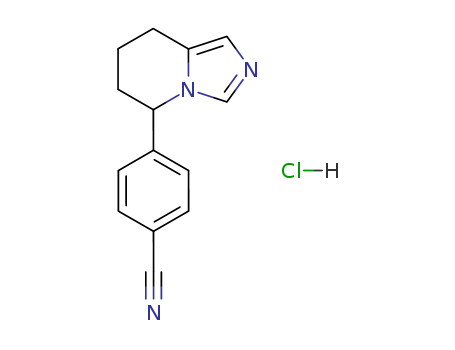
FADROZOLE HYDROCHLORIDE
- CAS: 102676-31-3
- Purity: 99%
- Reputable factory supply FADROZOLE HYDROCHLORIDE 102676-31-3 in bulk at low price
Reputable factory supply FADROZOLE HYDROCHLORIDE 102676-31-3 in bulk at low price
- Molecular Formula:C14H13 N3 . Cl H
- Molecular Weight:259.738
- Vapor Pressure:1.95E-09mmHg at 25°C
- Melting Point:231-233℃
- Boiling Point:481.7°Cat760mmHg
- Flash Point:245.1°C
- PSA:41.61000
- Density:g/cm3
- LogP:3.48248
FADROZOLE HYDROCHLORIDE(Cas 102676-31-3) Usage
|
Manufacturing Process |
5-p-Cyanophenyl-5,6,7,8-tetrahydroimidazo[1,5-a]pyridine hydrochloride:A solution of 2.0 g of 4-(4-chloro-4-p-cyanophenyl-n-butyl)-1H-imidazole in 50 ml of chloroform is refluxed for 4 hours under nitrogen, cooled and evaporated to yield the 5-p-cyanophenyl-5,6,7,8-tetrahydroimidazo[1,5-a]pyridine hydrochloride; melting point 231-233°C (from 2-propanol).Preparation of the starting materials:A solution of 1.82 g of 4-(3-ethoxycarbonylpropyl)-1H-imidazole in 30 ml of tetrahydrofuran under nitrogen is treated with 0.5 g of sodium hydride (50% oil dispersion) at 0°C for 30 min and 1.45 ml of trimethylsilyl chloride at 0°C for 3 hours. The reaction mixture is washed with cold 0.5 N sodium bicarbonate solution, dried over sodium sulfate and evaporated to dryness. The oil is redissolved in 100 ml of methylene chloride at -78°C under nitrogen and 12.82 ml of diisobutylaluminum hydride (1.56 M) is added dropwise. The reaction mixture is stirred for 5 min at -78°C, quenched with 1 ml of methanol followed by 10 ml of water and filtered through Celite?. The organic phase is separated, dried over sodium sulfate and evaporated to yield the title compound (a).(b) 4-(4-p-t-Butylaminocarbonylphenyl-4-hydroxy-n-butyl)-1-trimethylsilylim idazole:6.95 g of p-tert-butylaminocarbonylbromobenzene is dissolved in 175 ml of tetrahydrofuran at -70°C under nitrogen and 20.1 ml of a solution of n-butyl lithium (2.7 m) in hexane is added dropwise. After reacting 30 min, a solution of 5.69 g of 4-(3-formyl-n-propyl)-1-trimethylsilyl imidazole in 10 ml of tetrahydrofuran is added slowly. The reaction mixture is allowed to warm slowly to room temperature and 20 ml of ammonium chloride is added. The organic layer is separated, dried over sodium sulfate and evaporated to yield the title compound (b).(c) 4-(4-Chloro-4-p-cyanophenyl-n-butyl)-1H-imidazole:A solution of 4.5 g of 4-(4-p-t-butylaminocarbonylphenyl-4-hydroxy-n-butyl)- 1-trimethylsilylimidazole in 50 ml of thionyl chloride is refluxed for 1 hour, cooled and evaporated. The residue is partitioned between methylene chloride and aqueous sodium bicarbonate solution. The organic phase is separated, dried over sodium sulfate and evaporated to yield the title compound (c).5-p-Cyanophenyl-5,6,7,8-tetrahydroimidazo[1,5-a]pyridine:A solution of 2.0 g of 4-(4-chloro-4-p-cyanophenyl-n-butyl)-1H-imidazole in 50 ml of chloroform is refluxed for 4 hours under nitrogen, cooled and evaporated to yield the 5-p-cyanophenyl-5,6,7,8-tetrahydroimidazo[1,5- a]pyridine. |
|
Therapeutic Function |
Antineoplastic |
|
Biochem/physiol Actions |
Fadrozole is a nonsteroidal aromatase inhibitor. Fadrozole is a very potent and highly selective inhibitor of the aromatase enzyme system in vitro and estrogen biosynthesis in vivo. It inhibited the conversion of [4-14C]androstenedione to [4-14C]estrone by human placental microsomes in a competitive manner (Ki = 1.6 nM). At a substrate concentration 3-fold the Km, Fadrozole was 180 times more potent, as an inhibitor, than aminoglutethimide (Cat. No. A9657), exhibiting half-maximal inhibition at 1.7 nM as compared to 0.3 μM. In vivo, Fadrozole lowered ovarian estrogen synthesis by gonadotropin-primed, androstenedione treated, immature rats by 90% at a dose of 260 μg/kg (PO). In vivo, Fadrozole leads to sequelae of estrogen deprivation (e.g. regression of DMBA-induced mammary tumors) without causing adrenal hypertrophy in adult rats. It blocked aromatase by 50% in human breast cancer homogenates, live breast cancer cells, human placental microsomes, and porcine ovarian microsomes at concentrations of 0.008 to 0.02 μM. |
|
Brand name |
Afema |
InChI:InChI=1/C14H13N3.ClH/c15-8-11-4-6-12(7-5-11)14-3-1-2-13-9-16-10-17(13)14;/h4-7,9-10,14H,1-3H2;1H
102676-31-3 Relevant articles
Nickel-Catalyzed Reversible Functional Group Metathesis between Aryl Nitriles and Aryl Thioethers
Delcaillau, Tristan,Boehm, Philip,Morandi, Bill
supporting information, p. 3723 - 3728 (2021/04/07)
We describe a new functional group metat...
102676-31-3 Process route
-

-
102676-30-2
5-(3-chloropropyl)-1-<(4-cyanophenyl)methyl>-1H-imidazole

-
![(+/-)5-(p-cyanophenyl)-5,6,7,8-tetrahydroimidazo[1,5-a]pyridine hydrochloride](/upload/2026/6/313f6969639c45c38acb4cc031355f76_9b86e33b-cb59-44b5-a8e0-f6b993266445.png)
-
102676-31-3
(+/-)5-(p-cyanophenyl)-5,6,7,8-tetrahydroimidazo[1,5-a]pyridine hydrochloride
| Conditions | Yield |
|---|---|
|
5-(3-chloropropyl)-1-<(4-cyanophenyl)methyl>-1H-imidazole;
With
potassium tert-butylate;
In
tetrahydrofuran;
at 0 - 20 ℃;
With
hydrogenchloride;
In
1,4-dioxane;
|
63% |
-

-
1879-16-9
1-methoxy-4-methylsulfanyl-benzene

-
-
102676-31-3
(+/-)5-(p-cyanophenyl)-5,6,7,8-tetrahydroimidazo[1,5-a]pyridine hydrochloride
-
![5-(4-(methylthio)phenyl)-5,6,7,8-tetrahydroimidazo[1,5-a]pyridine](/upload/2026/6/7515427bb4b1469caf32e8b7a64f2143_31bfbaa2-bfd3-46f0-a24e-22627c4be67b.png)
-
5-(4-(methylthio)phenyl)-5,6,7,8-tetrahydroimidazo[1,5-a]pyridine
| Conditions | Yield |
|---|---|
|
With
bis(1,5-cyclooctadiene)nickel (0); lithium hexamethyldisilazane; 1,2-bis-(dicyclohexylphosphino)ethane;
In
o-xylene;
at 140 ℃;
for 24h;
Glovebox;
Inert atmosphere;
|
62% |
102676-31-3 Upstream products
-
102676-30-2
5-(3-chloropropyl)-1-<(4-cyanophenyl)methyl>-1H-imidazole