
Categories
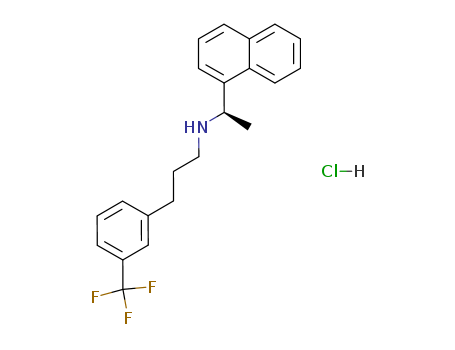
Cinacalcet hydrochloride
- CAS: 364782-34-3
- Purity: 99%
- Factory Sells Best Quality Cinacalcet hydrochloride 364782-34-3 with USP
Factory Sells Best Quality Cinacalcet hydrochloride 364782-34-3 with USP We supply high quality Cinacalcet hydrochloride (CAS 364782-34-3), in stock, factory directly supply to clients, lower prices, more competitiveness.
What is the Cinacalcet hydrochloride ?
Cinacalcet hydrochloride is Off-white to tan solid, while it's Molecular Formula is C22H22F3N.HCl. Cinacalcet hydrochloride can be used in clinical trial in secondary hyperparathyroidism.
What is the CAS number for Cinacalcet hydrochloride ?
The CAS number of Cinacalcet hydrochloride is 364782-34-3.
More information of Cinacalcet hydrochloride 364782-34-3 are:
|
Synonyms |
Mimpara;Regpara;Sensipar;1-Naphthalenemethanamine,a-methyl-N-[3-[3-(trifluoromethyl)phenyl]propyl]-,hydrochloride, (aR)-(9CI); |
|
CAS?Number |
364782-34-3 |
|
Molecular Formula |
C22H22F3N.HCl |
|
Molecular Weight |
393.88 |
|
Melting Point |
175-177 °C |
|
Boiling Point |
440.9 °C at 760 mmHg |
|
Flash Point |
220.5 °C |
|
HS CODE |
29214990 |
|
PSA |
12.03000 |
|
LogP |
7.33490 |
What is Cinacalcet hydrochloride (364782-34-3) used for?
Cinacalcet is the first entry in a new class of therapeutic agents called the calcimimetics. It was launched as an oral treatment for secondary hyperparathyroidism (SHPT) in patients with chronic kidney disease on dialysis and for hypercalcemia in patients with parathyroid carcinoma. SHPT is associated with increased parathyroid hormone (PTH) secretion, which is triggered by low serum levels of calcium resulting from the failure of the kidney to clear phosphorous from the body and its inability to produce sufficient quantities of vitamin D. The consequences of increased PTH include stimulation of osteoclastic activity, cortical bone resorption and marrow fibrosis. PTH secretion is primarily regulated by the calcium-sensing receptor (CaR), which is located on the surface of the chief cell of the parathyroid gland. Calcimimetics bind to CaR and increase the sensitivity of CaR to extracellular calcium, thereby enabling its activation at subnormal levels of serum calcium. As a result, in the presence of these agents, the low levels of endogenous calcium in patients with renal failure are able to exert a suppressive effect on PTH secretion. Parathyroid carcinoma is also associated with elevated PTH levels, which are driven by autonomous parathyroid gland activity and subsequently lead to hypercalcemia. Although surgical resection is the primary therapy for treating hypercalcemia in parathyroid carcinoma patients, calcimimetics offer a nonsurgical alternative for patients with failed parathyroidectomy, metastatic parathyroid carcinoma, or high surgical risk. The recommended dosage of cinacalcet for the treatment of SHPT in chronic kidney disease is 30mg once daily at start and subsequent titration to 60, 90, 120 or 180 mg once daily. The dosage for the treatment of hypercalcemia in patients with parathyroid carcinoma is 30 mg twice daily at start and subsequent titration to 60 or 90 mg twice daily, or 90mg three or four times daily as necessary to normalize serum calcium level. After oral administration of cinacalcet, maximum plasma concentration is achieved in approximately 2 to 6 hours. It has a terminal half-life of 30 to 40 hours and steady-state drug levels are reached within 7 days. Cinacalcet has a high volume of distribution (1000 L) and high protein binding (93%–97%). It is extensively metabolized in the liver, mainly by CYP3A4, CYP2D6 and CYP1A2. The primary routes of elimination are in the urine (80%) and in the feces (15%). In Phase III clinical trials involving 1136 patients with SHPT, administration of cinacalcet at 30–180 mg/day doses for 6 months produced 38–48% decrease in intact PTH. Overall, 64% of patients given cinacalcet achieved at least a 30% reduction in PTH, versus 11% of placebo patients. Calcium-phosphorous product was reduced 14% by the active treatment and did not change in the placebo group. In a much smaller clinical study involving 21 hypercalcemic patients with parathyroid carcinoma, administration of 60–360 mg/day doses of cinacalcet resulted in 71% of patients achieving a target reduction of ≥1 mg/dL in serum calcium. The most common adverse events in these trials were nausea and vomiting. In vitro, cinacalcet is a strong inhibitor of CYP2D6; therefore, dose adjustments may be required when coadministered with medications that are predominantly metabolized by CYP2D6 and have a narrow therapeutic index (e.g. flecainide, vinblastine, thioridazine and most tricyclic antidepressants). Cinacalcet is prepared in a two-step synthesis starting from 3-[3-(trifluoromethyl)phenyl]propionaldehyde, by first condensing with (R)-(1-naphthyl)ethylamine to form the corresponding imine and subsequent reduction of the imine with sodium cyanoborohydride.
InChI:InChI=1/C22H22F3N.ClH/c1-16(20-13-5-10-18-9-2-3-12-21(18)20)26-14-6-8-17-7-4-11-19(15-17)22(23,24)25;/h2-5,7,9-13,15-16,26H,6,8,14H2,1H3;1H/t16-;/m1./s1
Articles related to Cinacalcet hydrochloride:
|
Article |
Source |
|
Preparation method of cinacalcet hydrochloride |
- , (2021/05/26) |
|
Cinacalcet intermediate and synthesis method of cinacalcet hydrochloride |
- Paragraph 0155; 0158; 0171-0173, (2021/07/17) |
How to get the best price on Cinacalcet hydrochloride?
Neworld Chemical Co., Ltd Shanghai is a quality supplier and manufacturer of Cinacalcet hydrochloride . You can buy high quality, low price Cinacalcet hydrochloride 364782-34-3 here. Contact us.